Bachelors thesis
Library of Narva old town
Year: 2026 spring semester (IV year)
Typology: Public building
Location: Narva, old town

Before World War II, Narva was known as the Baroque Pearl of the North. The war almost completely destroyed Narva's historic Old Town and surrounding districts. After the war, the historic city center was redeveloped into a modern residential area of Soviet-era apartment blocks following a free-plan urban layout.
As part of the bachelors thesis project, a library was designed for a site next to historical Narva Town Hall, following the scale and urban form of the pre-war city quarter. The library serves as an ode to pre II world war Narva's historic Old Town.
Following the end of World War II, Estonia came under Soviet occupation, and Narva began to be rebuilt according to the ideological principles of the new regime. The new street network no longer followed the pre-war urban fabric, and prefabricated apartment blocks were erected in arbitrarily chosen locations.
In the mid-1950s, an order from Moscow mandated the removal of all war ruins. In Narva, even the structurally restorable remains of historic buildings were demolished, erasing virtually everything that had been built over centuries. Fortunately, the foundations, cellar walls, and sections of the original street paving were left intact beneath the surface.
Narva's fate was ultimately shaped by the discovery and mining of uranium in Ida-Viru County. The city became a major transit hub for transporting uranium throughout the Soviet Union. As a result, many former residents were prohibited from returning to their hometown, while tens of thousands of workers from elsewhere in the Soviet Union were brought in. For many of these newcomers, the historical identity and future of Narva held little personal significance.


1. Pre-war buildings.

2. Ruins of pre-war buildings, ontop of which has erected a park and new buildings.

3. A new building that follows the volumes, roofscape, opening locations, and plot boundaries of the pre-war urban block. The building's southern façade is cut back to respond to the existing built environment.

4. Diagonal cuts in the façade reveal the interior ruins to the street while creating cantilevered volumes that respond to the existing vehicular and pedestrian traffic along the street.

Pre war city

Buildings renovated after the war

Pre war + after war buildings

Site plan

View from the corner of Rüütli and Suur streets
The double façade, consisting of a perforated outer screen and a glazed inner façade, creates the perception of a more spacious streetscape within the narrow streets. It also allows the preserved ruins to be exhibited to people on the streets while the perforated outer layer maintains the historic street line of the former buildings. Diagonal cuts at the building's corners lend the structure a sense of lightness, creating the impression that the corners are lifted and that the building opens its interior to those passing along the street.

The ruins retained within the building are integrated as tactile, space-defining elements, avoiding their reduction to museum objects displayed behind glass. A generous ground-floor atrium exposes the landscape of the ruins, enabling visitors to experience the presence of the pre-war buildings and to understand the former arrangement of their spaces.

-1. floor plan


Ground floor plan


1. floor plan

2. floor plan

View from the Suur street
The building's southern façade is cut to respond to the existing surrounding buildings. To distinguish this cut surface from the rest of the building façade, it is clad in mirrored glass.

Section 2

Section 1
From the Town Hall Square side, visitors can descend to the underground level, where the ruins are experienced in the open air at their original elevation. This sunken void runs alongside the Rüütli Street façade, culminating in a staircase that returns to street level at the corner of Rüütli and Pagari Streets.


West elevation/ along Suur street

Hoonet ümbritsevas perforeeritud fassaadis on erinevad mustrid vastavalt sõjaeelsete kruntide piirjoonte asukohtadele.
Perforeeritud fassaadil olevad aknaavad asuvad samas kohas, kus asusid sõjaeelsete hoonete aknad.
South elevation/ along Väike-Viru street
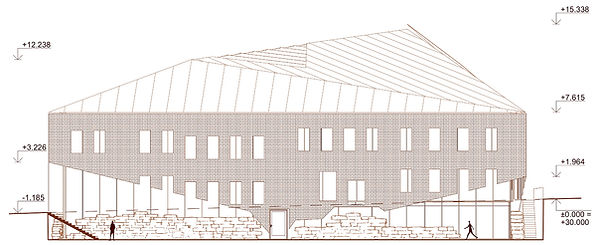
North elevation / along Rüütli street

East elevation / along Pagari street

Reconstructed portal
_edi.jpg)
Some of the most distinguished buildings in Narva's former Old Town were adorned with magnificent Baroque portals. The finest examples were located along Rüütli Street and around Town Hall Square.
Fortunately, an extensive photographic record of all the portals has survived, and fragments of several portals are preserved in the Narva Museum. These sources make it possible to accurately reconstruct the portals in their original form and reinstall them as sculptural objects at their historic locations.
Each reconstructed portal is accompanied by an interpretive information panel describing both the portal itself and the history of the building to which it once belonged.
Glassed opening in the ground
The street level of Narva's pre-war Old Town was significantly lower than it is today. Archaeological excavations carried out in the 1990s revealed that the original pre-war street pavements have survived beneath the present-day surface.
The newly constructed streets incorporate viewing windows made of tempered glass, allowing visitors to look down from the contemporary street level onto the centuries-old cobblestone pavements below.
_edi.jpg)

Cityscape section

Axonometric view


View along the Rüütli street

